




Commercial and Office Window Shades in NYC
Glare off the screens, heat off the floor, and one clean line across the glass. Fitted out of hours.
Nobody complains about the windows. They complain about the screens.
An office shade has one job that matters more than the rest: making the glass survivable for people looking at a monitor eight hours a day.
Glare on a screen is not a comfort issue, it is a productivity one. People turn their desks around, tape paper to the window, or move to a different bank of desks and leave a whole side of the floor empty. Every one of those is a symptom of the same thing.
Video calls made it worse and more visible. A person sitting with a bright window behind them is a silhouette, because the camera exposes for the brightest thing in frame. A solar shade behind the desk fixes on every call what no amount of lighting in front of them will.
The answer is almost always a solar shade in a fairly tight weave — three or five per cent — which cuts the glare and the heat while keeping enough view that the floor does not feel boxed in. Slatted blinds throw stripes of light across a desk as the sun moves, which is the specific thing people find hardest to work under.
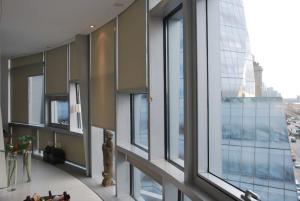
Forty feet of glass is one shade, not eight
On a continuous run the eye reads the whole line. One shade sitting an inch off its neighbours undoes the look of the entire floor.
Every opening gets measured on its own even where the mullions look evenly spaced, because in a real building they are not. Limits are set per motor so the group finishes level, and the shades are then zoned by elevation rather than by room — the south glass on one control, the west on another, because they need the sun at different times.
Where a run is long we use a coupled headrail so several shades move as one physical unit. It stays in step permanently, which a set of independent motors will not do on its own over a few years.

Your landlord may have already chosen the fabric
Most Class A office buildings in New York specify a building-standard window shade: a particular fabric, a particular colour facing out, sometimes a particular manufacturer, so the tower reads as one building from the street rather than a patchwork of tenant choices. It is in the tenant fit-out manual, and it is enforced at sign-off.
It constrains less than it sounds. The requirement is nearly always about the outward-facing side and the visible line at the head. What happens on the room side, and whether the shades are manual, motorised or automated, is usually yours to decide.
Send us the fit-out manual or the relevant lease clause before anything is specified. Finding out at sign-off that the fabric is wrong means buying the shades twice, and the second set is not cheaper.
A conference room needs two shades, not one
Conference rooms are the one place in an office where a single fabric genuinely cannot do the job. During the day the room needs the glare off the table and the screen while staying a pleasant place to sit, which is a solar shade. For a presentation, a client review or a video call from a dark room, it needs to actually go dark, which is a dim-out or blackout fabric.
Two shades on one window, on separate controls or a shared headrail, solves it properly. Put them on a scene so the room has a “present” setting rather than a person standing on a chair at the start of every meeting.
Glass-walled meeting rooms have the opposite problem, which is being seen rather than seeing. That is usually solved with film or a dim-out roller on the interior glazing rather than anything on the exterior window.
Shades that move before anyone notices the sun
In an office nobody owns the shades, so nobody adjusts them. They end up down all day, which wastes the daylight and the view that the rent is partly paying for, or up all day while one side of the floor cooks.
Automating by sun angle fixes that. Shades drop on the elevation the sun is actually on and lift again when it moves round, on a schedule that follows the season rather than a fixed clock time. Nobody has to remember and nobody has to agree.
It also takes real load off the cooling system, because solar heat stopped at the glass never becomes something the plant has to remove. On a large glazed floor that is a running cost, not a rounding error, and it is one of the easier contributions to an energy or sustainability target.
Out of hours, insured, and off your critical path
Offices do not stop for a shade install. We measure and fit outside working hours as standard, agree the window before the order is placed, and work to the building’s rules on freight elevator booking, loading dock hours, protection of finishes and any union requirements on site.
The Certificate of Insurance naming the landlord and the managing agent is our job, filed before anyone arrives with tools. It is the most common reason a contractor is turned away at a commercial building and it is entirely avoidable.
On a fit-out we would rather be measuring from the drawings early and installing late, once the glass is in and clean, than be squeezed in at the end. Tell us the programme and we will fit around it.
Fabric for commercial spaces is specified to the flame-propagation standard your space requires and the certification comes with the job — the same as on our storefront and restaurant work.
What facilities and fit-out teams ask us
What window shades are best for an office?
Solar roller shades in a three or five per cent openness. They cut screen glare and solar heat while keeping enough view that the floor does not feel closed in. Slatted blinds are a poorer choice at desks, because they throw moving stripes of light across a monitor as the sun tracks round.
Do office shades have to match a building standard?
In most Class A buildings in New York, yes — the fabric and colour facing the street are specified in the tenant fit-out manual so the building reads as one facade. The room side and whether the shades are motorised are usually still your choice. Send us the manual before anything is specified.
Can shades fix glare on video calls?
Yes, and it is one of the most common reasons we are called now. A bright window behind someone makes the camera expose for the window and turns the person into a silhouette. A solar shade on that window solves it on every call, which adding lights in front of the person does not.
How do you keep a long run of shades level?
Every opening is measured individually, because evenly spaced mullions are rarely identical, and each motor has its limits set on its own so the group lands level. On long runs we couple shades to a shared headrail so they move as one unit and stay in step over time.
Can commercial shades be automated?
Yes, and in an office they usually should be, because shades nobody owns are shades nobody adjusts. Zoning by elevation and running to a sun-angle schedule keeps the glare off without anyone deciding, and it takes real load off the cooling system.
Do you install outside business hours?
Yes, as standard. Evenings, early mornings and weekends, working to the building’s rules on elevator booking, dock hours and site protection. The window is agreed before the order is placed rather than negotiated on the day.
Do commercial shades need fire-rated fabric?
In spaces the public uses, generally yes, and it is checked at inspection or by a landlord’s insurer. We specify to the standard your space requires and supply the certification with the job. There is more on this on our storefront and restaurant page.
Do you work with landlords and fit-out contractors?
Regularly, both directly for tenants and as part of a fit-out package. We can measure from drawings early and install once the glass is in, and we handle the insurance and building access paperwork ourselves so it does not land on your programme.
We will come and look at the floor
Site visit, measurement and a written quote, at no cost. Offices, lobbies, meeting rooms and whole fit-outs across Manhattan, Brooklyn and Queens.
500 7th Avenue, 9th Floor, New York, NY 10018 · Monday to Friday, 9am–5pm