


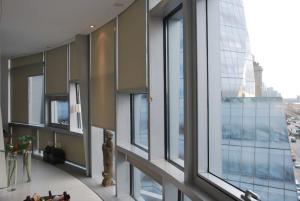


Floor-to-Ceiling Window Treatments in NYC
When the window is the wall, the rules change. Here is what actually works.
A tall window is not a big version of a small one
Almost everything that goes wrong on floor-to-ceiling glass comes from one of four things: nobody can reach the top, there is nothing solid to fix into, the fabric has to carry its own weight over a long drop, and the light gets in at the floor.
A shade over a four-foot kitchen window forgives a lot. The same product over a twelve-foot drop does not. The tube has to be wider or it sags in the middle. The fabric has to be heavier or it flutters and curls. The bracket has to hold a load that a plasterboard fixing will not hold. And once it is up, no one is climbing a ladder every morning to open it.
None of that is a reason to avoid floor-to-ceiling treatments. It is a reason to have them measured and fitted by people who have done it before, because a mistake at that size is expensive and not returnable.
There is nothing to screw into
This is the problem people do not see coming. In a newer Manhattan or Long Island City building, the outside wall is a curtain wall — a frame of aluminium mullions holding sealed glass units. It is the building’s weather skin. Drilling into a mullion breaks the seal and the thermal break, and most buildings will not allow it. Some leases and house rules say so in writing.
So the fixing goes somewhere else. Usually the ceiling slab just inside the glass, or a recess or pocket built into the ceiling, or a header board fixed back to structure above the plasterboard. Which one is right depends on what is actually above your ceiling, and that is something we establish on the measuring visit rather than on the day of the install.
In a pre-war conversion the opposite problem appears. There is plenty to fix into, but it is old plaster over masonry, nothing is plumb, and the drop can vary by half an inch across a single opening. Both situations are normal here. Neither is a surprise.
Nobody is opening that by hand
On tall glass, motorisation stops being a luxury and becomes the only way the treatment gets used.
A shade you cannot reach is a shade that stays where it was left. We fit motors on tall drops as a matter of course, and we set them up, group them and demonstrate them before we leave.
Battery motors suit a finished apartment: nothing is opened up, and they charge every few months. On a very long drop the motor works harder, so we size the battery for the actual weight rather than the catalogue number. Hardwired motors never need charging and are the right answer during a renovation, when a wire to the head of the window costs almost nothing to run.

Six shades on one wall have to move as one
A single tall window is straightforward. A run of five or six across a living room is where the job is won or lost, because the eye reads the line across the top and the line across the bottom instantly. If one hem sits a quarter of an inch below its neighbour, that is the thing you will look at for the next ten years.
Getting it right means templating every opening separately even when they look identical — in an older building they never are — and then setting the limits on each motor individually so the group lands level. We control them as one group afterwards, from a single remote, an app or a voice command, so the wall opens and closes together.
The same applies to a corner. Two runs meeting at a right angle need the same drop and the same fabric roll direction, or the corner will look wrong from across the room.
A glass wall is a heat problem before it is a light problem
West and south-facing glass in New York gains a lot of heat, and a floor-to-ceiling window gains far more of it than a punched window does simply because there is more glass. Your air conditioning fights it every afternoon in summer. Furniture, art and timber floors fade in front of it.
A solar shade blocks that heat before it enters the room while still letting you see out. The trade-off is openness: a tighter weave blocks more heat and keeps less of the view, a more open weave keeps the view and blocks less. Three per cent and five per cent are the usual choices on a view apartment. We show you both against your own glass, at the time of day the sun is actually on it, because the difference does not photograph.
Where the room is also a bedroom, two shades on one window is the honest answer — a solar shade for the day and a blackout shade behind it for the night. One fabric cannot do both jobs well, and any supplier who tells you otherwise is selling you the compromise.
What the street sees is often not your choice
Many New York condo and co-op buildings specify what the outside of your window treatment may look like. Usually that means a white or off-white liner facing the street, so the facade reads as one building rather than a patchwork. It is written into the house rules and it is enforced.
This does not limit what you see from inside. A shade or drape can be any colour and any fabric on the room side with a compliant liner on the glass side. It only becomes a problem when it is discovered after the order has been cut, which is why we ask for your building’s rules before anything is made.
We also carry the Certificate of Insurance your building requires before an installer is let in, naming the corporation and the managing agent exactly as the board asks. Insurance paperwork is the most common reason a contractor gets turned away at the door, and it is our job rather than yours.
What people ask us about tall windows
What window treatments work best for floor-to-ceiling windows?
Roller shades, and drapery on a ceiling-mounted track. Both hang cleanly over a long drop and neither needs anything to stand on the floor. Solar roller shades are the usual first choice on a view apartment because they keep the view; drapery is added where the room needs softness, warmth or a bit of sound absorption.
Venetian and vertical blinds are generally the wrong answer at this height. The slats are heavy over a long drop, they rattle, and they cut the view into stripes that you paid not to have.
Do floor-to-ceiling shades have to be motorised?
Not by any rule, but in practice yes above about nine feet. The top of the shade is out of reach, and a manual chain long enough to reach a twelve-foot head rail is both unpleasant to use and a hazard around children. Every tall installation we do is motorised unless the customer has a specific reason otherwise.
Can you install shades on a glass curtain wall?
Yes, but not into the mullions. The frame is part of the building’s weather seal and most buildings prohibit drilling it. We fix to the ceiling slab, into a ceiling pocket, or to a header carried back to structure. Which one applies is decided at the measuring visit, once we know what is above your ceiling.
How do you make a wall of windows line up?
Every opening is measured and templated on its own, even where they appear identical, and every motor has its limits set individually so the group finishes level. They are then controlled together as one group. Trusting that six openings in an older building are the same size is the single most common way this job goes wrong.
What is the best shade for a west-facing glass wall?
A solar shade, chosen for openness rather than colour. Three per cent blocks most of the heat and glare and keeps a usable view; five per cent keeps more of the view and blocks less. If the room is also slept in, add a separate blackout shade rather than trying to make one fabric do both.
How much do floor-to-ceiling shades cost?
It depends on the width and drop, the fabric, and whether the motors are battery or hardwired — those decide almost all of it. A long run of motorised shades is a serious piece of work and we would rather quote it accurately than advertise a number that turns out not to apply to your windows. The consultation, the measuring and the written quote are free.
Can I have floor-to-ceiling curtains if I rent?
Usually yes. A ceiling-mounted track fixes with small screws that patch and paint over in minutes, and battery motors need no wiring at all, so nothing permanent is done to the apartment. Tell us you are renting at the consultation and we will mount in the least invasive position and keep the hardware reusable so it moves with you.
How long does it take?
Custom shades for a tall run are typically a few weeks from order, and the fitting itself is normally one visit. Hardwired motors add electrical work and we tell you that when we quote, not on the day. If access needs a lift or the building only permits work at certain hours, that goes in the quote too.
We will come and look at the glass
We bring the fabric samples to your apartment, measure every opening, and leave you with a written quote. No cost, no obligation.
Book a free consultation212.222.8288
500 7th Avenue, 9th Floor, New York, NY 10018 · Monday to Friday, 9am–5pm · Manhattan, Brooklyn, Queens and the surrounding boroughs