


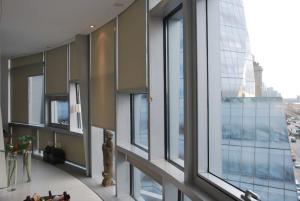


Storefront and Restaurant Window Shades in NYC
Kill the glare without hiding the window. Fabric that passes a fire inspection. Fitted after you close.
Your window is doing a job. It has to keep doing it.
In an apartment a shade is allowed to close. A shopfront is different: the window is how people find you, so anything you put on it has to solve the sun without hiding what is behind the glass.
That single constraint rules out most of what gets sold as a commercial window covering. Blinds with slats close the view. Blackout fabric turns a lit interior into a blank wall after dark. Film is permanent, and it cannot be adjusted when the sun moves.
What works on a street-facing window is almost always a solar shade — a woven fabric that stops heat and glare while keeping the view through it — sized and mounted so the display, the signage and the door all still read from the sidewalk.
What the sun costs you, in stock and in covers
A west-facing window in New York takes direct sun for hours. Retailers pay for that in faded stock; restaurants pay for it in tables nobody will sit at.
Colour goes first, and it goes unevenly — the side of the garment or the packaging that faces the glass fades while the rest does not, which turns display stock into markdown stock. Timber, leather and printed card are the worst affected.
In a dining room the damage is simpler. The two or three tables in the window become unusable between roughly two and six in the afternoon, and they are usually the tables people ask for. A solar shade at the right openness gives them back without taking away the view that made them desirable.

The part that fails an inspection
This is the thing that catches people out, and almost nothing written about commercial blinds mentions it. Fabrics hung in a space the public uses generally have to meet a flame-propagation standard — in practice that means NFPA 701 — and a restaurant, bar, shop or lobby is such a space. A residential fabric ordered online will not carry that certification.
It usually surfaces at the worst moment: at inspection, at fit-out sign-off, or when a landlord’s insurer asks for documentation on a space that is already trading. Replacing shades at that point costs more than specifying them correctly did.
We specify rated fabric for commercial work as standard and we give you the certification with the job, so it is in your file before anybody asks for it. If your space has a specific requirement from the landlord or the fit-out drawings, send it to us and we will match it.
A solar shade works one way, and night reverses it
Worth understanding before you buy, because it surprises people. A solar shade gives you privacy in daylight because the outside is brighter than the inside — you can see out, the street cannot see in. After dark, with your lights on, that reverses completely. The room becomes the bright side and the shade becomes close to transparent from the sidewalk.
For a shop that is usually fine and often desirable: a lit window at night is advertising. For a restaurant, a bar or a treatment room it is often not, and the honest answer is two layers on the same window — a solar shade for the afternoon and a denser or dim-out fabric for the evening, on the same headrail or on separate ones.
We will tell you which of these applies to your frontage on the site visit rather than selling you both by default.
What you may change, and what needs permission
New York treats the outside of a building differently from the inside. Anything mounted on the facade — an awning, a canopy, exterior signage — needs permits, and inside a historic district it also needs Landmarks approval before it goes up. That process is real and it takes time.
Interior shades fitted behind the glass are a different matter and generally do not, because nothing is being altered on the facade itself. That is a large part of why interior solar shades are the usual answer for a landmarked frontage in SoHo, the Village or Tribeca: they solve the sun without touching the thing that is protected.
Your landlord or your BID may still specify what colour faces the street, exactly as a residential co-op does. Send us the lease clause or the tenant fit-out manual before anything is ordered and we will work inside it.
You do not close for this
A shop that shuts for a day to have shades fitted has paid for them twice. We measure and install commercial work outside trading hours as a matter of course — early morning, after close, or overnight where the building allows it — and we agree the window before the order is placed rather than on the day.
Commercial buildings usually want a Certificate of Insurance naming the landlord and the managing agent before anyone is let in with tools, the same way a residential co-op does. We file it. Freight elevator booking, loading-dock hours and any union requirements at the building are part of the schedule we plan around, not surprises on the morning.
We also motorise commercial shades on a timer where the sun is predictable, which most street frontages are. The shades drop when the sun comes round and lift again afterwards, without anyone on shift having to remember.
What shop and restaurant owners ask us
What window shades work best for a storefront?
Solar roller shades, in an openness that suits how much of the display has to stay visible. They cut heat and glare while keeping the view through the glass, which is the whole point of a shopfront. A three per cent fabric blocks more and shows less; five and ten per cent keep more of the display readable from the sidewalk.
Slatted blinds and blackout fabrics are usually the wrong choice on a street window, because both hide what you are trying to show.
Do commercial window shades need to be fire rated?
In a space the public uses, generally yes. The standard usually asked for is NFPA 701, and residential fabric bought online will not carry it. It is normally checked at inspection, at fit-out sign-off, or by a landlord’s insurer. We specify rated fabric for commercial work and supply the certification with the job.
Will shades stop my window display fading?
They reduce it a great deal, but nothing removes it entirely. Solar fabric blocks a large share of the ultraviolet and the visible light that does the damage. A denser weave protects more. Rotating what sits in the window still matters, particularly with textiles, leather and printed packaging.
Can people still see my display through a solar shade?
In daylight, yes — that is what separates a solar shade from a blind. How clearly depends on openness. At night the effect reverses: with your lights on the shade reads as almost transparent from the street. That is good advertising for a shop and often wrong for a restaurant, which is why dining rooms frequently need a second, denser layer for the evening.
Can you install without closing the store?
Yes. Commercial installations are done outside trading hours as standard, and we agree that window before the order is placed. Where a building restricts working hours or requires a freight elevator booking, that goes into the schedule too.
Do I need Landmarks or DOB approval for storefront shades?
For interior shades behind the glass, generally not, because the facade is not being altered. Anything mounted on the outside — an awning, a canopy, exterior signage — does need permits, and in a historic district it needs Landmarks approval as well. This is the main reason interior solar shades are the usual answer on a landmarked frontage.
What can I do about the window tables in the afternoon?
Fit solar shades on that elevation and, if the sun is predictable, put them on a timer so they drop before service rather than after a guest has complained. Choose openness by what the view is worth: a good view justifies a more open weave and a little more heat, a car park does not.
How much do commercial shades cost?
It depends on the run of glass, the fabric and the specification, and on whether the shades are motorised. Fire-rated commercial fabric costs more than residential fabric and should be budgeted for. We survey the site, measure, and give you a written quote at no cost.
We will come and look at the frontage
Site visit, measurement and a written quote, at no cost. Shops, restaurants, bars, offices and lobbies across Manhattan, Brooklyn and Queens.
500 7th Avenue, 9th Floor, New York, NY 10018 · Monday to Friday, 9am–5pm